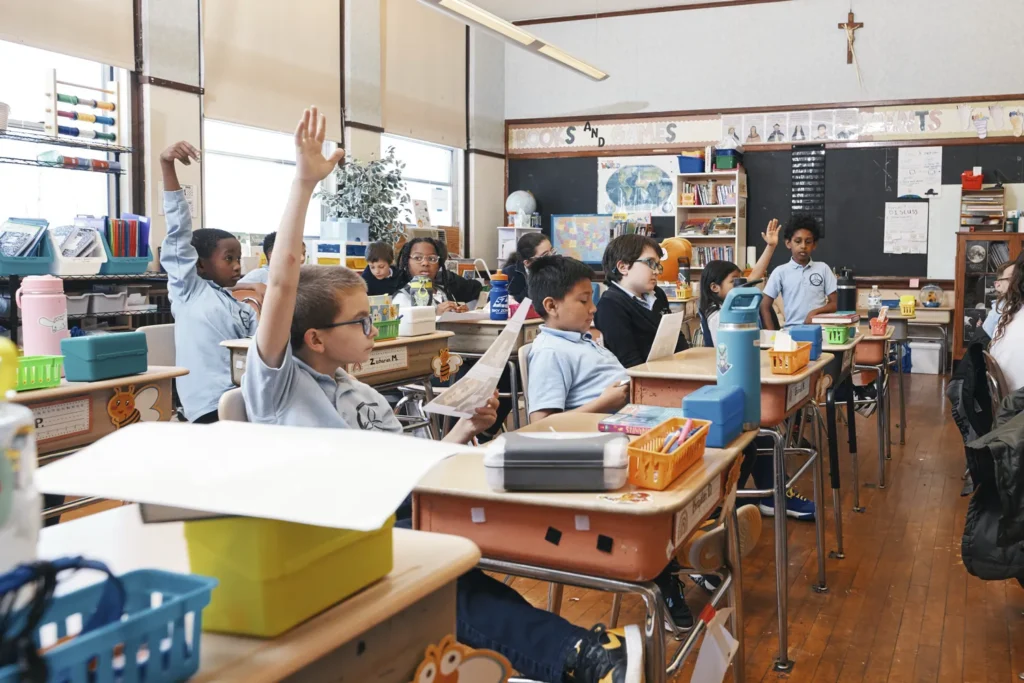
We meet all curricula standards set by the Archdiocese of Boston and students are taught to understand their own giftedness by God and the giftedness of others.
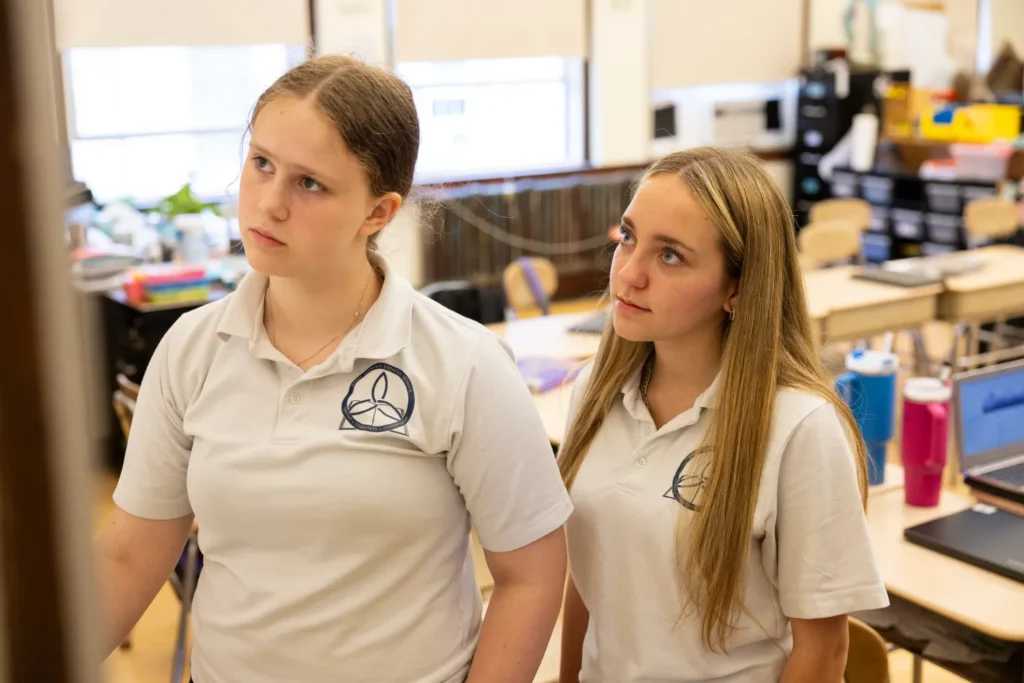
Our students are known, loved, and challenged by our teachers and faculty.
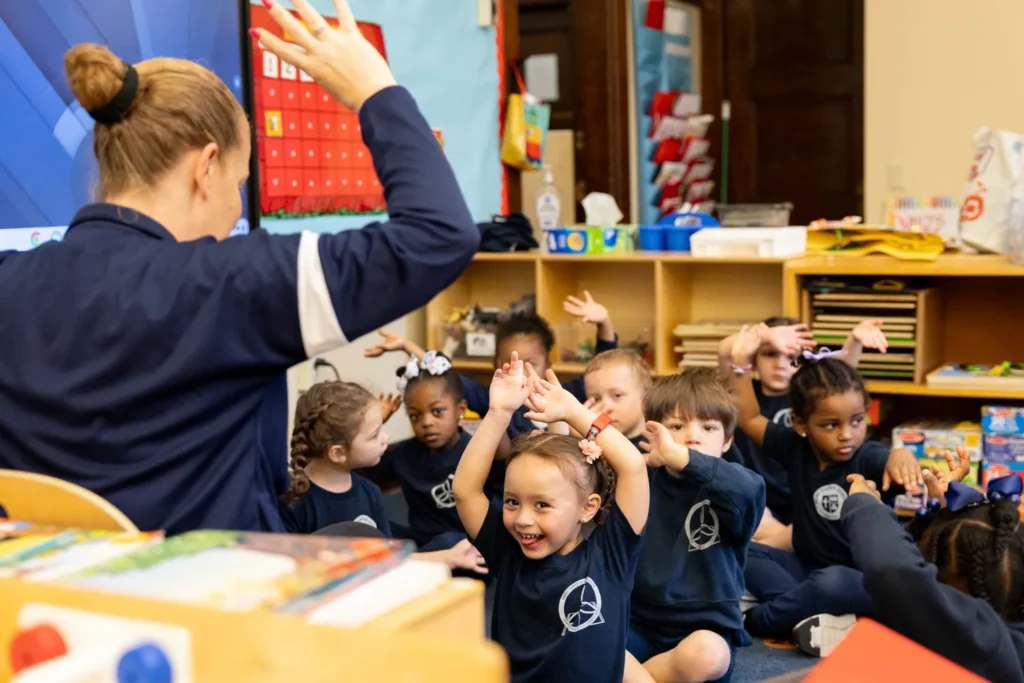
Our Pre-Kindergarten 2.9-3-year-old classroom is designed for three-year-old children. In our room, we use the portions of the “Handwriting Without Tears” preschool program to help prepare our children for Kindergarten. Each day, we listen to a story, sing songs, and practice letter/sound recognition. Weekly, children are engaged in pre-reading, writing, math, and science activities to help build their understanding and ease their transition to a four-year-old program. We encourage social play and help children foster loving relationships within their new school community. With weekly religion lessons, coupled with daily prayer, children will learn about God and the love that He has for him/her. Together, we will work to best meet your child’s individual needs!
The goal of the Three-Year-Old curriculum is to provide opportunities for total learning through consideration of all areas of development: spiritual, emotional, social, physical, intellectual, and creative. The curriculum is developed to meet the needs of the preschoolers in all of these areas using hands-on activities, while keeping the whole child in mind in order to develop self-confidence and self-esteem as they learn to navigate the world around them.
Language Arts
The overall goal of the Three-Year-Old Language Arts program is to lead students to understand the makeup of the spoken and written word. Students are introduced to the alphabet and how it works. They are provided with an introduction to how the sounds of our language work together. Students are provided with early reading and writing experiences in which they can be successful. We help students to focus, not only on the importance of learning but also the joy that learning brings.
Mathematics
The goal of the Three-Year-Old Mathematics program is to introduce students to the foundations of mathematical understanding and the basic skills necessary to begin a lifelong learning of mathematical concepts. Students will learn numbers 1 through 10 and beyond if able. Using manipulatives, they will learn to solve simple addition and subtraction problems. Students will begin to learn shapes and recognizing patterns. Books, math games, and math manipulatives will be used to reinforce money concepts, counting, and one-to-one correspondence. They will count on the calendar each day and then to the 100th day of school to reinforce rote counting.
Social Studies
The overall goal of the Three-Year-Old History and Social Science Program is to provide students with the knowledge and skills needed in community life and begin development of their civic identity. To accomplish these goals students will be exposed to ordinal vocabulary on a daily basis. They will hear read-aloud stories about holidays, historical times, and community helpers. Students will be active participants in implementing classroom rules and completing classroom jobs. They will engage in dramatic play to act out appropriate situations and different periods in history. Students will participate in field trips to observe the community in action. Holidays will be observed in an educationally appropriate way.
Science
The goal of the Three-Year-Old Science and Technology program is to provide children with the skills needed to explore, experiment, and discover their world. They will use scientific tools in the correct manner while learning basic concepts to build a foundation in the use of scientific experimentation and exploration. Through this, we hope for children to attain some insight and understanding about their world and themselves by sharpening their senses and contributing to their total development.
Health
The overall goal of the Three-Year-Old Health Education program is to develop both gross and fine motor skills and introduce ways to keep safe and healthy. These practices will be accomplished through the use of the “Second Step” program, modeling healthy habits by teachers and aides in the classroom, and read-aloud books that build on the healthy habits practiced. Our enrichment program, our early childhood cooking class, Physical Education class, recess time in the schoolyard, and at the local playground will be used to reinforce these concepts as well.
Religion
The goal of the Religion program in the 3-Year-Old classroom is to lead students toward a strong, healthy relationship with the church community and to introduce rules of morality and a connection to God. They will learn about God’s love for them, identify religious holidays, observe and practice examples of caring for others, and develop a comfort level in church through visits. To accomplish these goals, children will participate in daily prayers and discussions about God, do activities on a weekly basis, and act out situations in which they can model Christian behavior.
Creative Arts
The overall goal of the Three-Year-Old Creative Arts program is to develop and sustain natural curiosity, expressiveness, and creativity. These goals will be accomplished through experimentation, exploration, and engagement of the senses using many different materials and mediums. Students will also participate in weekly or bi-weekly music and art programs.
Our Pre-Kindergarten 2.9-3-year-old classroom is designed for three-year-old children. In our room, we use the portions of “Handwriting Without Tears” preschool program to help prepare our children for Kindergarten. Each day we listen to a story, sing songs, and practice letter/sound recognition. Weekly, children are engaged in pre-reading, writing, math, and science activities and to help build their understanding and ease their transition to a four-year-old program. We encourage social play and help children foster loving relationships within their new school community. With weekly religion lessons, coupled with daily prayer, children will learn about God and the love that He has for him/her. Together, we will work to best meet your child’s individual needs!
The goal of the four-year-old curriculum is to provide opportunities for total learning through consideration of all areas of development: spiritual, emotional, social, physical, intellectual, and creative. The curriculum is developed to meet the needs of the preschoolers in all of these areas using hands-on activities while keeping the whole child in mind in order to develop self-confidence and self-esteem as they learn to navigate the world around them.
Language Arts
The overall goal of the Kindergarten 1 Language Arts program is to lead students to understand the makeup of the spoken/written word. Students are introduced to the alphabet and how it works. They are provided with an introduction to how the sounds of the language work together. Students are provided with early reading and writing experiences in which they can be successful. We help students to focus not only on the importance of learning but also on the joy that learning brings. To accomplish these goals, students will spend time in group activities, having the opportunity to experience the role of speaker and listener. They will engage in play experiences in which they can practice these skills. They will follow a daily schedule of reading and writing experiences. Students will learn interactively through the acting out of stories that have been read aloud and the formation of class books that they have authored. They will be introduced to poetry through age-appropriate books and recordings, along with finger plays and songs that are learned throughout the year. Assessment will be done through observation of children’s writing and reading skills and leveled assessments as needed.
Math
The goal of the Kindergarten 1 Mathematics program is to introduce students to the foundations of mathematical understanding and the basic skills necessary to begin a lifelong learning of mathematical concepts. To accomplish these goals, students will use various materials to count, arrange, and practice one-to-one correspondence. They will participate in a cooking class to practice measuring and deciphering rebus recipes with numbers. Books will be used to reinforce money concepts, counting, and one-to-one correspondence. They will count to the 100th day of school to reinforce rote counting. Math Shelf math activities will be done weekly, along with fingerplays, songs, and games used to reinforce math concepts. Assessment will be accomplished using teacher observation and assessment
Social Studies
The overall goal of the Kindergarten 1 History and Social Science Program is to provide students with the knowledge and skills needed in community life and begin development of their civic identity. To accomplish these goal,s students will be exposed to ordinal vocabulary on a daily basis. They will hear read-aloud stories about holidays, historical times, and community helpers. Students will be active participants in implementing classroom rules and completing classroom jobs. They will engage in dramatic play to act out appropriate situations and different periods in history. Students will participate in field trips to observe the community in action. Holidays will be observed in an educationally appropriate way. Assessment will be done through teacher observation and projects based on concepts.
Science
The goal of the PreK 4 Science and Technology program is to provide children with the skills needed to explore, experiment, and discover their world and use scientific tools in the correct manner while teaching basic concepts to build a foundation in the use of scientific experimentation and exploration. Through which we hope for children to attain some insight and understanding about their world and themselves by sharpening their senses and contributing to their total development. These goals will be accomplished through the process of hands-on exploration of many things. The children will gather their knowledge through play, experiments, exploration, and their own senses. Scientifically accurate books will be read and made available to the students. Simple experiments will be performed, and direct observation of the butterfly’s life cycle and the growth of plants will be used. Scientific tools will be available for exploration by the students on a daily basis. Activities will foster questions and observations and will stimulate the children to further explore.
Health
The overall goal of the Kindergarten 1 Health Education program is to develop both gross and fine motor skills and introduce ways to keep safe and healthy. These practices will be accomplished through the use of the “Second Step“ program, modeling healthy habits by teachers and aides in the classroom, and read-aloud books that build on the healthy habits practiced. Physical Education class and recess time in the schoolyard and at the local playground will be used to reinforce these concepts.
Religion
The goal of the Religion program in the 4-Year-Old classroom is to lead students toward a strong, healthy relationship with the church community and to introduce rules of morality and a connection to God. They will learn about God’s love for them, identify religious holidays, observe and practice examples of caring for others, and develop a comfort level in church through visits. To accomplish these goals, children will participate in daily prayers and discussions about God, do activities on a weekly basis, and act out situations in which they can model Christian behavior.
The Kindergarten program focuses on solidifying the skills necessary for reading and basic mathematics. Students participate in a classroom learning environment based on the guidelines set forth by the Archdiocese of Boston and the Common Core. We utilize a diverse curriculum program along with teacher-created lessons to assure that each student is progressing at a developmentally appropriate pace that is individualized according to skill level.
Language Arts
The overall goal of the Kindergarten Language Arts Curriculum is to assist students in the understanding of both the spoken and written word. Most students, at this stage of their educational career, have some knowledge of the alphabet and how it works, so this curriculum strives to strengthen that knowledge by giving them the opportunity to see how the sounds of the language work together. It provides those students with reading and writing experience to experiment with more information and enhance their prior knowledge, and it provides those students who are just becoming readers and writers with the information to begin their exploration. We assist all students to focus on not only the actual “learning” portion of Language Arts but also on the joy of learning to read and write, because with the knowledge of reading and writing comes the “key” that will unlock all doors to learning and a vast imagination.
Mathematics
The overall goal in Kindergarten focuses on two critical areas. The first is representing, relating, and operating on whole numbers, initially with sets of objects. The second is describing shapes and space. More learning time is devoted to the concept of numbers to ensure that all parts are understood. Students will attain these concepts through a series of events; i.e., practiced exercises, teacher presentation/class discussion, and demonstration. We also employ the use of games and drill exercises, along with cooperative learning. Learning is assessed through chapter tests and role play.
Religion
The purpose of the Kindergarten Religion Program is to assist students in knowing God and Jesus and to celebrate his life and teachings. They will also learn the primary aspects of the Church and appropriate behavior in God’s house. The students will obtain this knowledge through different methods such as group projects (large and small), hands-on activities, role-playing, prayers, songs, games, and attending Mass.
Science
Science is a subject that encourages students to explore, experiment, and discover. It also nurtures a love and respect for our world and all living things. Through our experiments and exploration, we hope for the children to attain some insight and understanding about their world and themselves by sharpening their senses and contributing to their total development. The children will gather their knowledge through play, experiments, exploration, and their own senses. Activities will foster questions and observations and will stimulate the children to further explore.
Social Studies
The purpose of our History/Social Science Program is to develop an understanding of the world we live in and how we’ve arrived at the place we are in today. The program fosters an awareness, appreciation, and respect for our American heritage and for our ancestry and how they all work together. The program instills a knowledge of our world and its diversity and shows us that working together earns us the right to be citizens of the world through our knowledge.
A partial schedule (2 or 3 day; or half-day) is available for families. For more information, please contact our office.
8:00: School Day begins with Morning Prayer
8:15: Open Areas
9:15: Morning Circle/Literacy Circle
9:45: Bathroom Break & Snack
10:!5: Story Time and Instruction Centers
11:30: Recess
12:00: Lunch
12:30: Drop Everything And Read
1:00: Quiet Time & Nap
1:45: Discovery Time & Free Play
2:30: Closing Circle
2:45: Dismissal
Language Arts
Students will gain and strengthen previous phonetic awareness, recognize and understand the conventions of print and books, further explore the alphabet, begin to develop comprehension skills, strengthen and build their vocabulary, and begin the basics in writing. Students are read to on a regular basis, participate in Saint Theresa’s Drop Everything and Read (D.E.A.R.) daily reading program, share whole group or small group lessons, write book reports and author studies, create reading logs, and create and perform presentations/demonstrations. The students have daily exposure to phonemic awareness; continual use of decodable books; use sound/spelling cards; have daily spelling work, and keep a list of the most commonly misspelled words to practice.
Mathematics
In Grade 1, instructional time focuses on four critical areas: (1) number and operations in base ten; (2) operations and algebraic thinking; (3) measurement and data; and (4) geometry. Our curriculum and lessons feature clear, step-by-step visual representations. Skills are introduced and practiced through varied and graduated exercises. This can be seen through pictorial and concrete introductions. Students will apply strategies they learn to solve and formulate problems of their own. Moreover, children learn to use critical thinking skills, mental math, and logical reasoning to solve problems.
Religion
The purpose and objective of Religion in Grade 1 is to enable the students to obtain active faith through active learning. This is accomplished by explicit instruction in Catholic vocabulary and practices. The first-grade Religious education will be taught through numerous methods, including faith journals, which contain questions and exercises for the child’s own personal exploration and family involvement, one-minute retreats, reflections, and prayer for the day, graphic organizers to visualize the lesson, and using text and pictures to help children comprehend the lesson.
Science
Students will gain an understanding of basic life, physical, and earth sciences. This is accomplished through teacher-made units, topics, and exercises ranging from the life cycle of a frog to changes in seasons to weather. Students will gain practical knowledge, such as how to dress for the weather and the many uses of the sun. The children will gather their knowledge through play, experiments, exploration, and their own senses. Activities will foster questions and observations and will stimulate the children to further explore.
Social Studies
Through Social Studies, students in Grade 1 will be introduced to topics and skills of civics, geography, history, and economics. This will be integrated with reading, writing, speaking, and numeracy. Students will also study the physical and human geography of our land. Students will discover world geography as well. Further, students will explore major events, persons, and institutions in our history. Students will explore families and communities, past and present, as well as local and foreign. We will go over local and regional communities, family and community-related topics in history and civics. Moreover, children will gain an understanding and appreciation of our natural resources and their duty to preserve them.
Language Arts
The overall goal of the Grade 2 Language Arts program is to help students continue to develop reading fluency, which leads to greater comprehension and enjoyment of reading. They gain the ability to use reading skills and strategies for inquiry and research. Students will sharpen their reading and writing skills by interacting with literature through continual reading and responding. We help students to focus not only on the importance of learning but also on the joy that learning brings. To accomplish these goals, the instruction focuses on daily exposure to phonemic awareness activities; continual use of decodable stories which cover phonics as well as reading fluency; daily spelling assignments; and all students participate in the daily D.E.A.R. program where they read books for pleasure. Students are read to on a regular basis and share in whole-group and small-group reading lessons. Children write book reports and give oral presentations. All students learn the writing process through the John Collins program.
Mathematics
In Grade 2, instructional time focuses on four critical areas: (1) number and operations in base ten; (2) operations and algebraic thinking; (3) measurement and data; and (4) geometry. The skills that were mentioned in the previous pages will be developed through lessons that feature clear, step-by-step visual representations. Skills are introduced and practiced through varied and graduated exercises. This can be seen through the pictorial and concrete introductions. Students will apply strategies they learn to solve and formulate problems of their own. Moreover, children learn to use critical thinking skills, mental math, and logical reasoning to solve problems.
Religion
Students will develop an understanding of the Trinity and our relationship with God and Jesus, and have a deepened awareness of the sacraments. Students will develop their morality and faith through: prayers, graphic organizers, text, pictures, songs, and assessment resources, such as reproducible master copies.
Science
Students will continue to gain an understanding of physical, earth, and life sciences. The science curriculum is a comprehensive collection of hands-on experiments, activities, and projects designed to develop scientific literacy in children. These projects will help children explore the wonders of the world in which they exist.
Social Studies
Grade 2 Social Studies Curriculum at St Theresa of the Child Jesus School is based on the Massachusetts State Frameworks while incorporating the Common Core Standards for literacy in History and Social Studies. The overall goal of the curriculum is to introduce students to topics and skills in the history, government, and economics of the United States. These skills will be integrated with reading, writing, speaking, and numeracy. Students will also study the political, physical, and cultural geography of our land and receive an introduction to world geography as well. Further, students will explore major events, persons, and institutions throughout our history. Students will explore families and communities, both past and present, from different areas of the country. Moreover, children will gain an understanding of what the meaning of citizenship is and how to be a positive, contributing member to their communities.
Language Arts
The goal of the Grade 3 Language Arts Curriculum is to help students enhance their reading fluency, build upon their comprehension of text, and begin to connect their written work with literature. We will read a wide variety of genres of literature, including biographies, poetry, and fiction. In using a wide variety, we will incorporate these into our major themes, such as reading, writing, phonics, spelling, grammar, penmanship, vocabulary, and research projects. This will help increase the student’s love of learning. Students participate daily in all areas of our language arts block throughout the curriculum. Students read for fluency/comprehension of text using a variety of strategies, such as context clues, visualization of events, character analysis, prior knowledge, and making predictions. Pictures walking and browsing are also used. Additionally, students work on summarizing and critical analysis techniques. Each week, children work with 20 vocabulary/spelling words that accompany each reading/subject type. Phonemic awareness skills are reviewed and integrated throughout. Students work in individual subject journals for a variety of skills, such as vocabulary, literary terms, and their own work. Each student keeps a poetry journal in which a new poem is read and interpreted each week with a poetic device. The John Collins Writing program is used throughout the curriculum. A portfolio is kept of all work to show strengths and areas of need as well as progress.
Mathematics
In Grade 3, instructional time focuses on four critical areas: (1) developing understanding of multiplication and division and strategies for multiplication and division within 100; (2) developing understanding of fractions, especially unit fractions (fractions with numerator 1); (3) developing understanding of the structure of rectangular arrays and of area; and (4) describing and analyzing two-dimensional shapes. These standards will be accomplished through classroom demonstrations and discussions. The use of manipulatives in in-class lessons and work in cooperative groups. At times, students will be asked to write or draw how they got their answer in their math journal. The teacher will use drill exercises in class and at home. Approximately every three weeks, students will have tests. Students will get the chance to play math games and use calculators and software programs. Students will understand that the knowledge of math facts and problem-solving strategies will help them in other areas of their lives.
Religion
The overall goal of the Grade 3 religion curriculum is to develop an understanding of the basics of Christian/Catholic doctrine, morality, and scripture. The religion program presents the complete Catholic catechesis, through a variety of themes (Creation, Worship, Service, Sacraments, etc.) within the context of the Church community. Teachers and students rely on their everyday experiences and immediate environment (classroom, family, and school) to present, explore, and apply the concepts and ideas taught in the religion program.
Science
The overall goal of the Grade 3 Science Curriculum is to continue to explore various scientific concepts within the main scientific domains (earth, life, and physical). The science curriculum is a comprehensive collection of hands-on experiments, activities, and projects designed to develop scientific literacy in children. These projects will help children explore the wonders of the world in which they exist. Grade 3 Focus on inquiry, minerals, weather, soil, weathering and erosion, solar system objects, plants and photosynthesis, motion, energy, and technology.
Social Studies
The overall goal of the Grade 3 History and Social Science Curriculum is to introduce the topics and skills of geography, history, civics/government, and economics. This program guides and supports students in developing geographic literacy, early understanding of major historical events (United States history and introduction to world history), a sense of the link between past and present, and familiarity with basic economic concepts and skills. The knowledge students will acquire through the Third Grade History and Social Science Program is ultimately aimed at helping them to become well-informed, confident, compassionate, and responsible members of their classroom/school, family, national, and world communities.
Language Arts
The purpose of the Fourth Grade Language Arts Program is to develop students’ literacy in reading and writing as well as help develop students’ listening, oral language, and vocabulary skills.
Mathematics
In Grade 4, instructional time focuses on 4 critical areas: (1) developing an understanding of multi-digit multiplication and division to find quotients involving multi-digit dividends; (2) developing an understanding of fraction equivalence, addition, and subtraction of fractions with denominators, and multiplication of whole numbers. (3) Understanding the geometric figures can be analyzed and classified based on properties such as having parallel sides, perpendicular sides, angle measures, and symmetry. These standards will be accomplished through classroom demonstrations and discussions. The use of manipulatives in in-class lessons and working in cooperative groups. At times, students will be asked to write or draw how they got their answer in their math journal. The teacher will use drill exercises in class and at home. Approximately every three weeks, students will have tests. Students will get the chance to play math games, use the smart board for interactive games, and use calculators and software programs. Students will understand that the knowledge of math facts and problem-solving strategies will help them in other areas of their lives.
Religion
The purpose of the Grade 4 Religion curriculum is to develop an understanding of the basics of Christian/Catholic doctrine, morality, and scripture. Students participate in various age-appropriate activities that help them learn about the Christian faith and demonstrate this knowledge in their everyday lives. The Religion Curriculum is taught through a series of instructional approaches. Students receive direct instruction, work in small groups, and participate in class discussions. The faith journal and activities from the workbook are done for each chapter. Students listen to Bible stories and sing hymns once a week. Art and writing projects are done on a regular basis to emphasize the importance of religion in all areas of life. Students learn, understand, and pray the Rosary once a week. Students also watch religious videos.
Science
The overall goal of the Grade 4 Science Curriculum is to continue exploring various scientific concepts within the main scientific domains (earth, life, and physical). The science curriculum is a comprehensive collection of hands-on experiments, activities, and projects designed to develop scientific literacy in children. These projects will help children explore the wonders of the world in which they exist. Grade 4 Focus: inquiry, rocks and minerals, fossils, earth and sun system, adaptations, different types of energy, magnetism, electricity, technology.
Social Studies
The Grade 4 Social Studies Curriculum at St. Theresa of the Child Jesus School is based on the Massachusetts State Frameworks while incorporating the Common Core Standards for literacy in History and Social Studies. Students will gain a better understanding of North America through its different countries and regions. Students study the physical and political geography, government, economics, and culture of the United States, Canada, Mexico, Central America, and the Caribbean Islands, and how geography affects the way people live. The five regions of the United States are studied in detail and the role each plays in the country and world today through the Five Themes of Geography: location, place, human-environment interaction, movement, and region. In addition, students receive an introduction to American history, government, and economics that will prepare them for an in-depth study of that curriculum in Grade 5.
Language Arts
The overall goal of the fifth-grade Language Arts Program is to develop students’ language abilities through spoken and written words. Students will learn to establish good English skills by learning the English language through various written and spoken exercises. Also, by using the Collins Writing Program, students will establish the confidence to communicate their thoughts and ideas on paper. To accomplish these goals, grammar and sentence structure will be taught. The teacher will help students understand how a proper sentence fits into a complete paragraph. First, students will understand the relationship between a subject and a verb by doing subject-verb exercises. Then, students will determine which words will complement the rest of the sentence by adding adjectives, adverbs, pronouns, prepositions, and nouns. After students construct a complete sentence, they will receive a topic and write a topic sentence. They will use this topic sentence to start a paragraph. Then, students will write supporting sentences, which will support the topic sentence. In addition, the teacher will make sure students’ supporting sentences are coherent and grammatically correct, according to the standards.
Mathematics
The purpose of the St. Theresa of the Child Jesus Fifth Grade Math Program is to provide Fifth-grade students with some of the most important foundational concepts in middle school math. Emphasis is placed on decimals and fractions, and gaining fluency in all four mathematical operations with them. There is more emphasis placed on algebraic thinking as well as geometry, measurement, and data. These concepts and skills are directly related to real-life, everyday situations students will encounter. These skills are taught through the use of manipulatives, drill practice, cooperative learning, problem-solving, and lectures. Students also keep a math journal where they must solve math problems and explain their reasoning. Students produce three to four longer pieces of writing using the John Collins Writing Program. The overall goal is to prepare the students for success at the middle school level and beyond in mathematics.
Religion
The purpose of the Fifth Grade Religion Curriculum is to teach the principles of Salvation History. The curriculum allows the students to gain knowledge on the important concepts of our faith: Creation, God, Jesus Christ, the Church, Christian Morality, the Sacraments, and Salvation. The Fifth Grade Religion curriculum is taught through the use of various teaching practices and strategies such as: direct instruction, guided reading, reading from the Bible and scripture, class discussion, cooperative learning groups, individualized and special instruction, problem-solving, attending Mass, and applying faith to everyday situations. Also, students will complete four writing pieces that define and illustrate their catholic faith. They will complete a compare-and-contrast paper that compares the catholic faith with other prominent faiths. They will also write a narrative piece on how God has worked in their life. Finally, students will construct an analytical and persuasive piece that further describes and proves their faith
Science
In Grade 5, students model, provide evidence to support arguments, and obtain and display data about relationships and interactions among observable components of different systems. By studying systems, Grade 5 students learn that objects and organisms do not exist in isolation and that animals, plants, and their environments are connected to, interact with, and are influenced by each other. They study the relationships between Earth and other nearby objects in the solar system and the impact of those relationships on patterns of events as seen from Earth. They learn about the relationship among elements of Earth’s systems through the cycling of water and human practices and processes with Earth’s resources. They also learn about the connections and relationships among plants and animals, and the ecosystems within which they live, to show how matter and energy are cycled through these (building on the theme of grade 4). An ability to describe, analyze, and model connections and relationships of observable components of different systems is key to understanding the natural and designed world.
Social Studies
The Grade 5 Social Studies Curriculum at St. Theresa of the Child Jesus School is based on the Massachusetts Curriculum Frameworks for Social Science, while incorporating the Common Core State Standards for literacy in History and Social Studies. The intention of the Grade 5 curriculum is to give students a solid, core understanding of the early developmental years of the United States. Students will gain a better understanding of the early Native American civilizations and the settlement of North America by European countries through the causes and effects of the Civil War. They will study the settlement and growth of the original thirteen English colonies and the beginnings of democratic ideals. Additionally, students will trace the events that led to the American Revolution and the development of the democratic form of government that we have today. Students will also produce four processed writing pieces using the John Collins Writing Program.
Language Arts
The purpose of the Grade 6 curriculum is for students to develop effective speaking, reading, and writing strategies along with an appreciation for literature. In addition, students will develop the tools needed to compose advanced formal writing as well as the tools utilized to evaluate literature effectively. The sixth-grade language arts curriculum is taught through a series of instructional approaches, such as independent reading, group reading, John Collins Writing Program, maintaining a writing folder for writing projects to view the individual writing process, and book reports with required responses. Students will also engage in oral presentations on trade books and literature pieces alone and in groups, book groups for trade books with comprehension questions and small group discussion, cooperative group projects, discussion and written answers to comprehension questions (detail, story elements, compare/contrast, drawing conclusions, making inferences, author’s purpose, cause/effect) and participation in large and small group discussions.
Mathematics
The purpose of the St. Theresa of the Child Jesus School Grade 6 Math Program is to provide a pathway to Algebra to ensure all students are college and career-ready when they graduate from high school. The curriculum is based on a combination of computation and problem-solving skills with emphasis on algebraic reasoning. These concepts and skills are directly related to real-life, everyday situations students will encounter. These skills are taught through the use of manipulatives, drill practice, cooperative learning, problem-solving, and lectures. The overall goal is to prepare the students for success at the high school level and beyond in mathematics. In grade 6, instructional time focuses on four critical areas: (1) developing understanding of and applying proportional relationships; (2) developing understanding of operations with rational numbers and working with expressions and linear equations; (3) solving problems involving scale drawings and informal geometric constructions, and working with two- and three-dimensional shapes to solve problems involving area, surface area, and volume; and (4) drawing inferences about populations based on samples. These skills build upon and reinforce skills from grade 5 and introduce new skills that will be used in grades 7 and 8.
Religion
The purpose of the Grade 6 Religion Curriculum at St. Catherine’s School is to teach the principle of Salvation History. The curriculum allows the students to gain knowledge on the important concepts of our faith: Creation, God, Jesus Christ, the Church, Christian Morality, the Sacraments, and Salvation. The Grade 6 Religion curriculum is taught through the use of various teaching practices and strategies such as: direct instruction, guided reading, reading from the Bible and scripture, class discussion, cooperative learning groups, individualized and special instruction, problem-solving, attending Mass, and applying faith to everyday situations. Also, students will complete four writing pieces that define and illustrate their catholic faith. They will complete a compare-and-contrast paper that compares the Catholic faith with other prominent faiths. They will also write a narrative piece on how God has worked in their life. Finally, students will construct an analytical and persuasive piece that further describes and proves their faith.
Science
The purpose of the Grade 6 curriculum is for students to investigate science and technology/engineering using a range of skills, habits of mind, and subject matter knowledge in the area of Environmental and Earth Science. This education will enable students to draw on the skills, habits, and subject matter knowledge in order to participate productively in the intellectual and civic life of society and to provide the foundation for their further education. The Grade 6 science curriculum is taught through a series of instructional approaches, such as direct instruction, cooperative learning groups, small group instruction, observation journals, the use of the Scientific Method, and experimentation. Students will also engage in hands-on activities, group projects, writing assignments through the John Collins Writing Program, Fall Plant growing project (2-month duration), Spring Science Fair Presentation, and Student Science Bowl
Social Studies
The Grade 6 St. Theresa Of The Child Jesus School Social Studies Curriculum is based on the Massachusetts State Frameworks and incorporates the Common Core Standards for literacy in History and Social Studies. Grades 6 and 7 form a two-year sequence in which students study regions of the world by examining physical geography, nations in the region today, and select ancient and classical societies before 1000 CE. Regions for grade 6 are: Western Asia, North Africa, and the Middle East; Sub-Saharan Africa; and Central America, the Caribbean, and South America. Students investigate guiding questions such as “How does geography affect how societies develop and interact?” and “How have human societies differed from one another across time and regions?”
Language Arts
The purpose of the St. Theresa of the Child Jesus Grade 8 Language Arts curriculum is to provide the student with the necessary skills needed to interpret and disseminate information with accuracy; to develop an aesthetic sense through the study of good literary models; to engender critical thinking; and to nurture creativity in thinking and expression. Students in Grade 8 will continue to refine and master skills taught in the 7th grade as outlined in the Massachusetts frameworks. In addition, an intensive study of literature is presented, while reinforcing basic reading skills learned in previous years. The John Collins Writing Program is used to strengthen student writing skills by incorporating the Massachusetts Frameworks and Common Core curriculum.
Mathematics
The purpose of the St. Theresa of the Child Jesus School Grade 7 Math Program is to provide a complete course in Pre-Algebra concepts. The curriculum is based on a combination of computation and problem-solving skills with emphasis on algebraic reasoning. These concepts and skills are directly related to real-life, everyday situations students will encounter. These skills are taught through the use of manipulatives, drill practice, cooperative learning, problem-solving, and lectures. The overall goal is to prepare the students for success at the high school level and beyond in mathematics. In grade 7, instructional time focuses on four critical areas: (1) developing understanding of and applying proportional relationships; (2) developing understanding of operations with rational numbers and working with expressions and linear equations; (3) solving problems involving scale drawings and informal geometric constructions, and working with two- and three-dimensional shapes to solve problems involving area, surface area, and volume; and (4) drawing inferences about populations based on samples.
Religion
The purpose of the Grade 7 Religion Curriculum is to teach the principle of Salvation History. The curriculum allows the students to gain knowledge on the important concepts of our faith: Creation, God, Jesus Christ, the Church, Christian Morality, the Sacraments, and Salvation. The Seventh Grade Religion curriculum is taught through the use of various teaching practices and strategies such as: direct instruction, guided reading, reading from the Bible and scripture, class discussion, cooperative learning groups, individualized and special instruction, problem-solving, attending Mass, and applying faith to everyday situations. Also, students will complete four writing pieces that define and illustrate their catholic faith. They will complete a compare-and-contrast paper that compares the catholic faith with other prominent faiths. They will also write a narrative piece on how God has worked in their life. Finally, students will construct an analytical and persuasive piece that further describes and proves their faith.
Science
The purpose of the Grade 7 curriculum is for students to investigate science and technology/engineering using a range of skills, habits of mind, and subject matter knowledge in the area of Life Science. This education will enable students to draw on the skills, habits, and subject matter knowledge in order to participate productively in the intellectual and civic life of society and to provide the foundation for their further education. The Grade 7 science curriculum is taught through a series of instructional approaches, such as direct instruction, cooperative learning groups, small group instruction, observation journals, the use of the Scientific Method, and experimentation. Students will also engage in hands-on activities, group projects, writing assignments through the John Collins Writing Program, a Fall Plant growing project (2-month duration), and a Spring Science Fair Presentation.
Social Studies
Grade 7 continues the sequence from grade 6, studying the development of ancient and classical civilizations and the physical geography of Asia, Oceania, and Europe. Students study these topics by exploring guiding questions such as, “How did the concept of self-government develop?” and “Why do empires rise and fall?” Additional supporting questions appear under each topic. The questions are included to stimulate teachers’ and students’ own questions for discussion and research.
Language Arts
The purpose of the St. Theresa of the Child Jesus eighth-grade Language Arts curriculum is to provide the student with the necessary skills needed to interpret and disseminate information with accuracy; to develop an aesthetic sense through the study of good literary models; to engender critical thinking; and to nurture creativity in thinking and expression. Students in the 8th grade will continue to refine and master skills taught in the 7th grade as outlined in the Massachusetts frameworks. In addition, an intensive study of literature is presented, while reinforcing basic reading skills learned in previous years. The John Collins Writing Program is used to strengthen student writing skills by incorporating the Massachusetts Frameworks and Common Core curriculum.
Mathematics
The St. Theresa of the Child Jesus eighth-grade mathematics program is based on the Massachusetts State Frameworks and the Common Core Curriculum. Students’ learning is a combination of computation, problem-solving skills, and independent thinking designed to strengthen the students’ foundational concepts needed to be successful in a high school Algebra I course and beyond. Students will continue to build on the pre-Algebra skills and concepts developed in Grade 7.
Religion
The purpose of the Eighth Grade Religion Curriculum is to teach the principles of Salvation History. The curriculum allows the students to gain knowledge on the important concepts of our faith: Creation, God, Jesus Christ, the Church, Christian Morality, the Sacraments, and Salvation. The Eighth Grade Religion curriculum is taught through the use of various teaching practices and strategies such as: direct instruction, guided reading, reading from the Bible and scripture, class discussion, cooperative learning groups, individualized and special instruction, problem-solving, attending Mass, and applying faith to everyday situations. Also, students will complete four writing pieces that define and illustrate their catholic faith. They will complete a compare-and-contrast paper that compares the catholic faith with other prominent faiths. They will also write a narrative piece on how God has worked in their life. Finally, students will construct an analytical and persuasive piece that further describes and proves their faith.
Science
The purpose of the eighth-grade curriculum is for students to investigate science and technology/engineering using a range of skills, habits of mind, and subject matter knowledge in the area of Physical Science and Space Science. This education will enable students to draw on the skills, habits, and subject matter knowledge in order to participate productively in the intellectual and civic life of society and to provide the foundation for their further education.
Social Studies
The purpose of the St. Theresa eighth-grade social studies program is to engage students in American civics, government, and economics, in such a way that is relevant to their lives. By studying the roots of America and its people, students will develop a greater understanding of their rights and responsibilities as American citizens. Eventually, they will become active adult members of American society who have the confidence to seek out equality, justice, and dignity for all. Specifically, students examine the historical and intellectual origins of the United States during the Revolutionary and Constitutional Eras. They learn about the important political and economic factors that contributed to the outbreak of the Revolution, as well as the consequences of the Revolution, including the writing and key ideas of the U.S. Constitution. Students also study the basic framework of American democracy and the basic concepts of American government, such as popular sovereignty, federalism, separation of powers, and individual rights. Students study America’s westward expansion, the establishment of political parties, and economic and social change. Finally, students will learn about the growth of sectional conflict, how sectional conflict led to the Civil War, and the consequences of the Civil War, including Reconstruction.